

Welcome to the Hand + Hammer Building Science Blog — your weekly deep dive into insulation types, building science, and the smarter way to build. Real knowledge, no fluff, straight from the field.
If you’ve ever gotten a bid for a remodel or new construction project and seen “insulation types” listed as a single line item with a number next to it, you’ve been on the wrong end of an oversimplification. Insulation is not a commodity. The product you choose, where you put it, and how it’s installed all matter. Your choice affects comfort, monthly energy costs, and how well the building holds up over time.
There are three insulation types you’ll encounter on most residential projects: fiberglass batts, mineral wool, and closed-cell spray foam. Each one works differently, performs differently, and belongs in different parts of a building. Understanding the distinction is worth your time before you ever break ground.
Insulation Types, Part 1: Fiberglass Batts
Fiberglass batts are what most people picture when they hear the word “insulation” — the pink fluffy rolls that have been stuffed into American wall cavities since the 1950s. They’re cheap, widely available, and easy to install, which is exactly why they became the default and have stayed there.
The way fiberglass works is straightforward: billions of tiny glass fibers trap still air, and still air is a poor conductor of heat. The more fiber, the more trapped air, and the higher the R-value — roughly R-3.2 to R-3.8 per inch. In theory, it’s a sensible system. In practice, fiberglass is one of the most unforgiving products in construction. Its performance depends almost entirely on installation quality. Any compression, any gap, any void around a wire or pipe — you’ve given up a meaningful portion of the R-value you paid for. Studies on existing homes routinely show fiberglass performing below its rated value. Small installation imperfections — ones nobody noticed and nobody fixed — are the culprit.
The other limitation is that fiberglass provides no air barrier. It slows air movement through a cavity slightly, but it does not stop it. Since air carries heat, any building assembly that relies on fiberglass alone to manage energy performance is leaving a significant gap in its strategy.
The Moisture Problem
There’s also a moisture consideration. Fiberglass absorbs and holds water. In a climate like San Francisco — where fog-driven humidity rolls in off the bay nearly every summer evening and buildings in neighborhoods like the Richmond, the Sunset, and Cole Valley live in a near-constant marine layer — fiberglass cavities that aren’t carefully vapor-managed can become slow-moving moisture problems. The insulation gets wet, its performance drops, and the conditions for mold and rot develop quietly behind finishes that look fine from the inside. Sacramento’s climate is drier, so moisture in the wall cavity is less of a daily concern there, but the installation precision problem still applies. At 104°F in July, a Sacramento wall with poorly installed batts full of voids is a thermal liability.
Of all the insulation types available, fiberglass batts make the most sense in budget-driven applications where the installation will be carefully supervised and the air barrier strategy is handled separately. When those conditions are met, they do their job. When they aren’t, they disappoint.
Insulation Types, Part 2: Mineral Wool
Mineral wool — sold under brands like Rockwool and Roxul — is made from volcanic rock or blast furnace slag that’s been melted and spun into dense, semi-rigid batts. It’s been the standard product in European residential construction for decades and has been building a serious following in the U.S. as more builders start paying attention to building science.
The density is the starting point for understanding why mineral wool outperforms fiberglass in most applications. It holds its shape in a wall cavity. The denser, more stable material eliminates the gaps and voids that plague fiberglass installation. It’s more forgiving to work with, and the finished assembly is more consistent. R-value runs about R-3.7 to R-4.2 per inch — a modest improvement over fiberglass, but the real gains come from the other properties it brings.
Mineral wool is hydrophobic. It actively repels water rather than absorbing it. Moisture that finds its way into an assembly can drain out and dry, rather than sitting and accumulating. In San Francisco, where humidity is a persistent background condition, that’s not a minor detail — it’s one of the primary reasons we reach for mineral wool first on Bay Area projects. Older homes in the city tell the story clearly. Victorian and Edwardian buildings make up a large portion of San Francisco’s housing stock. They were built with no insulation at all, and many are now being retrofitted for comfort and performance. Mineral wool is an ideal product for those applications because it handles the moisture environment those buildings live in without introducing new risk.
Fire Resistance and Sound Control
The fire resistance adds another layer of value. Mineral wool is non-combustible. It won’t ignite, and it won’t contribute to flame spread. Think about projects near the East Bay hills, Marin, or the Peninsula foothills. In those wildland-urban interface areas, fire resistance built into the wall assembly is a meaningful advantage. In Sacramento, where summer temperatures regularly hit triple digits and the surrounding foothills are increasingly subject to wildfire risk, the same argument applies with equal force.
Mineral wool also performs well acoustically. For an ADU with a shared party wall, or a San Francisco row home addition abutting a neighbor, sound transmission matters. The same density that makes mineral wool a strong insulator also makes it a solid sound barrier. It’s a property that shows up in quality-of-life ways long after the project is done.
Like fiberglass, mineral wool is not an air barrier on its own. It needs a well-coordinated assembly around it to reach its full potential. But as a cavity insulation product, it outperforms fiberglass in almost every category that matters, and the price difference on most projects is modest enough that it’s rarely a serious obstacle.
Insulation Types, Part 3: Closed-Cell Spray Foam
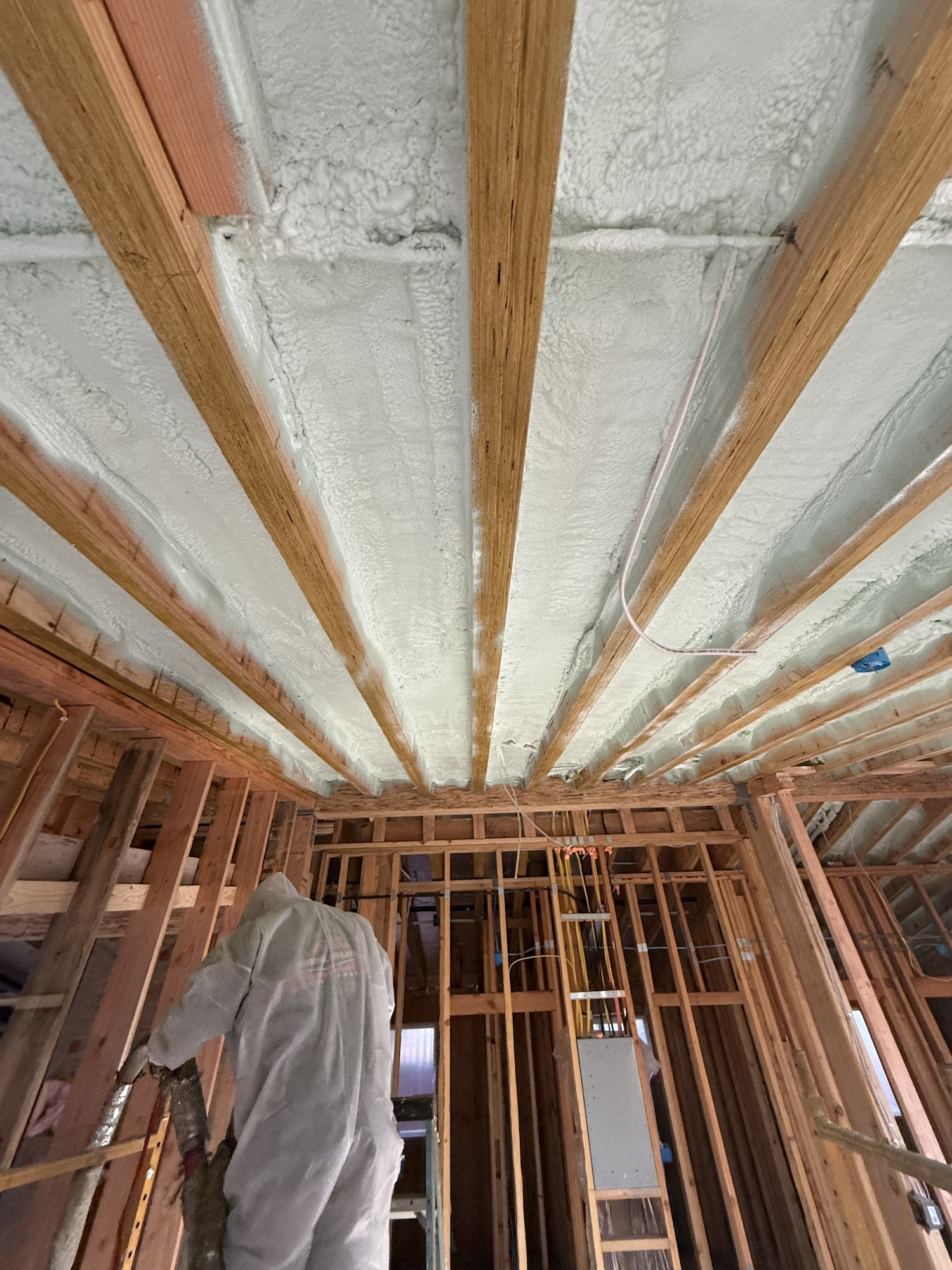
Closed-cell spray polyurethane foam is a different product category entirely — in how it works, what it costs, and what it can do that nothing else can. Two liquid components spray onto a surface and react on contact. They expand rapidly and harden into a rigid, dense foam that adheres to everything it touches, sealing every crack, gap, and penetration in the process. The result isn’t just insulation — it’s insulation and a continuous air barrier in a single application.
The R-value runs around R-6.0 to R-7.0 per inch. That’s the highest of any common residential insulation product. It matters enormously where space is limited and performance requirements are high. A two-inch application on a rim joist delivers more thermal resistance than a standard fiberglass batt. At the same time, it eliminates the air leakage path. Rim joists are one of the most significant energy loss points in most homes. Spray foam also adds structural rigidity to framed assemblies. At sufficient thickness, it functions as a vapor retarder. This simplifies moisture management in assemblies that are otherwise difficult to detail.
Where Spray Foam Performs Best
For San Francisco’s older building stock, spray foam is often the most practical solution in areas where you simply can’t install conventional insulation cleanly — irregular framing cavities, complex roof-wall intersections, areas with multiple utility penetrations. It reaches into corners, bonds to irregular surfaces, and creates an air-sealed assembly in conditions where batt products would leave gaps that no amount of care could fully close. Managing moisture is still a design responsibility with spray foam — a vapor-impermeable material on the wrong side of the assembly can trap moisture just as effectively as it blocks air — but a correctly designed assembly handles San Francisco’s marine climate well.
In Sacramento, one of the highest-value applications for closed-cell spray foam is an unvented conditioned attic — spraying the foam directly to the underside of the roof deck rather than on the attic floor. A standard vented attic in Sacramento hits 150°F or more on a hot summer day. That temperature radiates down into the living space, pushes the HVAC system hard, and significantly affects comfort even in well-insulated homes. Converting to a conditioned attic assembly dramatically reduces that heat load. It also protects ductwork from extreme temperatures. Homeowners notice the difference immediately. It’s one of the upgrades that Sacramento homeowners notice immediately after it’s done.
The costs and trade-offs are real. Spray foam is significantly more expensive than the alternatives, requires professional installation, involves chemicals that demand proper safety protocols and ventilation during application, and creates a more permanent assembly that makes future access more involved. It also raises ongoing conversations in the building industry about the environmental impact of certain blowing agents, though newer formulations are improving on that front.
Among the three insulation types, spray foam isn’t the right answer for every surface in every project. But in the applications where it belongs — rim joists, unvented roof assemblies, crawl spaces, complex retrofit conditions — it does things that no other product can replicate.
Why R-Value Is Only Part of the Story
R-value gets most of the attention in conversations about insulation types, but the factor that actually drives real-world performance is air sealing — and this is true in both San Francisco and Sacramento, just for different reasons.
Air carries heat. Outdoor air infiltrates through gaps, cracks, and unsealed penetrations. When it does, it bypasses your insulation entirely. The R-value on the label means nothing for the air that moves around it. In Sacramento, that means summer heat finding paths into your home that your insulation was never designed to address. In San Francisco, it means humid marine air infiltrating your wall cavities and creating moisture conditions that your insulation can’t do anything about.
This is why you should design air sealing and insulation as a system — not as separate line items. The specific products vary by project — ZIP System sheathing, rigid foam, spray foam in critical locations, taped housewrap, carefully sealed penetrations at every trade — but the goal is always a continuous, unbroken air barrier that makes the insulation perform the way its R-value suggests it should.
A house with average insulation and excellent air sealing will outperform a house with excellent insulation and average air sealing. When you get both right, the results speak for themselves.
Building It Right From the Start
The Right Time to Get It Right
The insulation and air barrier decisions you make at the beginning of a project are decisions you’ll live with for decades. They determine comfort, energy use, durability, and in certain climates, long-term structural health. They’re worth getting right the first time.
At Hand + Hammer Development, we’re a San Francisco design-build contractor that takes building science seriously — not as a selling point, but because we genuinely believe that a well-built home should perform as well as it looks. Whether you’re planning a kitchen remodel, designing an ADU, or building from the ground up, we bring this level of thinking to every project from the first conversation.
If you’re ready to build something that’s done right, we’d love to talk. Reach out to Hand + Hammer Development and let’s start the conversation.
Written by Eric Iturribarria
Eric Iturribarria is the founder of Hand + Hammer Development, a San Francisco design-build contractor specializing in high-performance kitchens, ADUs, and new construction. He brings a building science-forward approach to every project.
New posts every week. Next up: Air Sealing — What It Is, Why It Matters, and How We Detail It in the Field.
Hand + Hammer Development | San Francisco Design-Build Contractor | handhammerdev.com
One Response